Learning Goals
🦉 The Philosophy
Artificial Intelligence (AI) is not just a technical shift; it represents a fundamental restructuring of labor, power, and knowledge. Most MSU graduates will not be training AI models, but it is likely that they will be working alongside them. The suite of technologies that we call AI (e.g., machine learning, deep learning, generative AI) are not going back in the box, but we will eventually determine stable use cases for this tech.
CMSE 101 is designed to build critical thinking skills and a healthy skepticism by helping you develop the ability to use, evaluate, question, and push back on AI systems.
Each person in our classroom will have a different view and relationship to AI. Some of you might see it as an essential creative partner, others in our class might view it as a systemic threat. That diversity of perspective is a strength.
The goal of CMSE 101 is to develop AI Critical Thinking and to prepare you to navigate a workforce where AI tools are ubiquitous. You’ll learn to evaluate when and how to use AI, recognize its limitations, and question its outputs to ensure responsible decision-making.
🎯 Course Learning Goals
By the end of CMSE 101, students will be able to:
- Deconstruct and explain the underlying mechanics (conceptual, technical, mathematical) of ML/AI systems to evaluate their capabilities and limits.
- How does the AI work? What can it do? What can’t it do?
- Investigate and map structural and systemic bias in training data, algorithmic design, and historical interventions using primary and secondary sources.
- What is the data? Who is included? Who is excluded? What are the consequences of these choices?
- Critique the broader policy, environmental, and socio-technical impacts of AI by researching STS (Science and Technology Studies) theories.
- What are the societal implications of this AI system? Who benefits? Who is harmed?
- Perform metacognitive analysis on personal AI use, personal skill evolution, and collaborative team dynamics.
- How do I learn? How do I work with others? How do I use AI responsibly? What do I think about this particular use case?
- Translate complex technical AI trade-offs into actionable policy recommendations and accessible summaries for non-technical decision-makers.
- What should be done? How can we communicate this to others?
How will we achieve these goals?
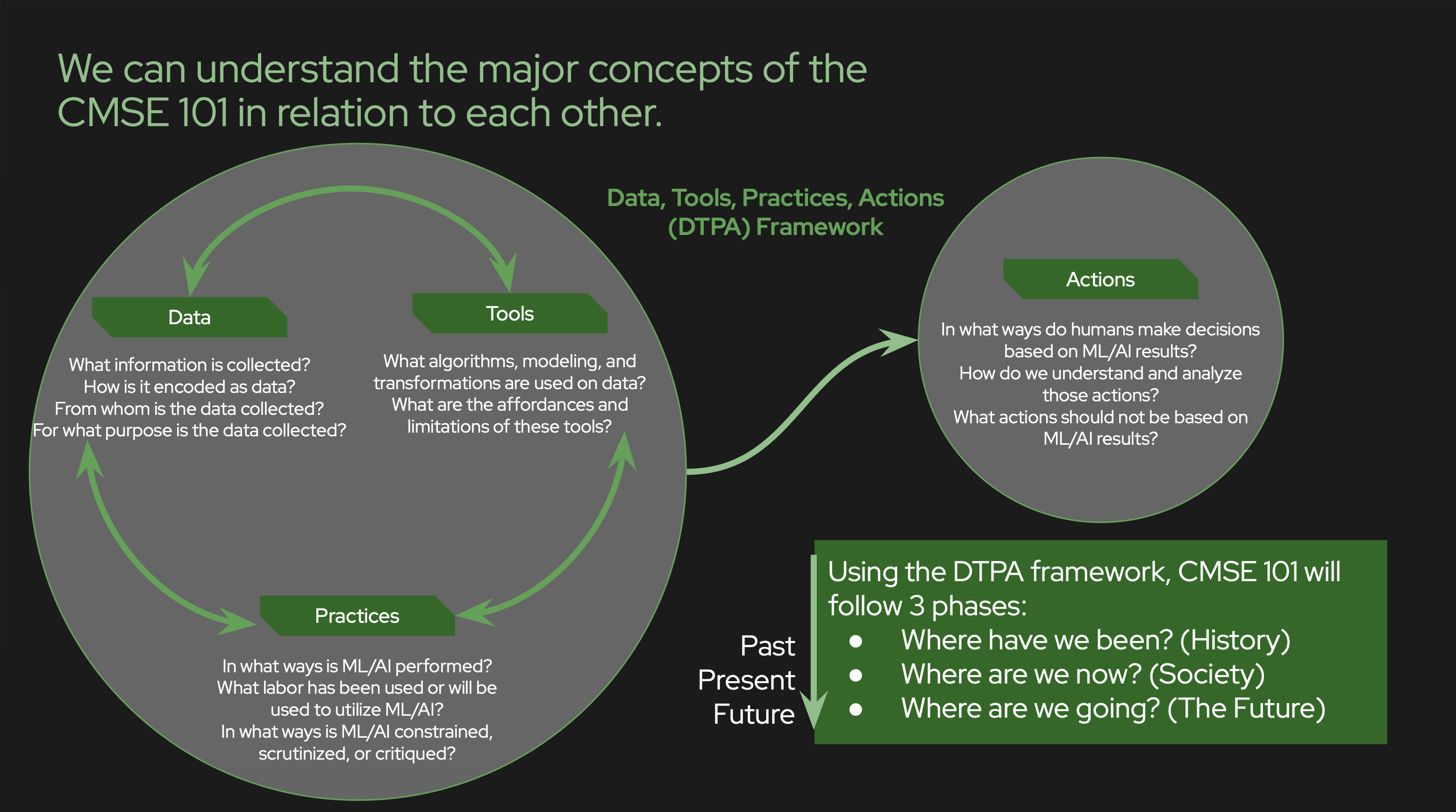
I. The DTPA Framework (Our Core Methodology)
Students will use the Data-Tools-Practices-Actions (DTPA) framework to deconstruct any AI use case.
By the end of the course, you will be able to:
- DATA: Deconstruct how information is encoded. You will identify what is collected, who is included/excluded, and how the technical processes of cleaning and manipulating data can erase or introduce important information. Through this you will learn to detect bias and inequity in the data that feeds AI systems, and how these biases can propagate through the system to produce harmful as well as benign outcomes.
- TOOLS: Understand the conceptual mathematics of Machine Learning and AI algorithms (e.g., Classifiers, LLMs, Neural Nets) without needing to code them. You will focus on the “logic of the machine” and the assumptions built into its architecture. You will get a chance to use these tools in a variety of contexts.
- PRACTICES: Analyze the how humans make use of these tools. You will identify what labor has been used to create datasets or the tools, how that labor is valued, and how the tool is deployed in practice. You will examine the ways in which those uses are evaluated, scrutinized, and constrained.
- ACTIONS: Evaluate the final outcome. You will determine if the system achieved its stated goal and how reaching that goal is determined. You will examine what actions are incentivized by the tool and who is empowered or marginalized by its deployment. You will ask if AI in particular contexts are being used to solve a real problem, are creating a new problem, or are being used to create a new market for a product or service.
II. The Four Pillars of AI Literacy
We measure success by your growth in these four depth-oriented literacies. These are the ways that allow us to hold multiple perspectives at once and navigate the utility of AI while remaining aware of its costs.
- Data Literacy: You will gain the ability to interrogate the provenance of data. You won’t just see a spreadsheet; you will see the labor of the people who labeled it and the identities of those it “erased” to make the model work. You will understand how the processing of data can erase or introduce important information and how the choice of what to include or exclude can reflect and reinforce societal biases.
- Quantitative Literacy: You will learn to interpret algorithmic reasoning. This means recognizing when a technical claim is “hollow” (i.e., using fancy math to mask a lack of evidence) and understanding the limits of what a model can predict or be used to do. You will examine the energy and labor costs of training models as well as the economics of these AI systems, and examine efficiency claims in the context of these hidden costs.
- Ethical Literacy: We move beyond simple “right vs. wrong.” You will analyze power dynamics of AI: Who is protected by this system? Who is targeted? Who is forced to be its subject? And what incentives does it create? This literacy helps you identify the trade-offs inherent in any high-stakes AI deployment, and to evaluate the ethical implications of design choices.
- Critical Literacy: You will learn to challenge the “inevitability” of AI. You will identify the specific financial and political motives behind the technology’s rollout. This allows you to evaluate the “Hype-Bro” narrative of AI while still finding the practical value the tool might offer your specific field. You will examine the narrative that AI is a solution to many problems, as well as the narrative that AI is an existential threat, and learn to navigate these extremes with a critical eye. Our goal is to develop critical pragmatism when engaging with AI by balancing skepticism with practical judgment to navigate its benefits and risks responsibly.
III. Chronological Inquiry Goals
Where have we been?
Artificial Intelligence is not a new technology. In fact, it’s a class of technologies that have been evolving for decades. We will examine the history of AI, from its early conceptualizations to its current applications, to understand how past developments inform present and future trends. This historical perspective will help you recognize patterns, anticipate challenges, and appreciate the long-term implications of AI in society.
Where are we now?
At present, AI is booming in its applications across various sectors. We will analyze contemporary AI systems, their societal impacts, and the ethical considerations they raise. This will involve case studies, current events, and hands-on projects that allow you to engage with AI technologies directly.
Where are we going?
The future of AI is exciting, anxiety-inducing, and uncertain. We will explore emerging trends, potential future applications, and the societal implications of these technologies. This forward-looking approach will encourage you to think critically about the role of AI in shaping our world and to consider how you can contribute to its responsible development and deployment.